StarIDAZ
Bringing a Global Animal Health Research Network into view
Project Overview
STAR-IDAZ is a global network of research funders, scientists and programme owners working together to align and coordinate animal health research worldwide.
The network coordinates research priorities for around 38 programme owners and funders across every continent, among them the World Organisation for Animal Health, Defra and CRA-W in Belgium. Together they direct close to three billion pounds towards research on 20 priority topics, from Coronavirus to Bovine Tuberculosis to Influenza. The consortium’s roadmaps map every piece of research needed to reach a vaccine, a diagnostic test or a control method, with live projects plotted against them so funders can see exactly where the gaps sit.
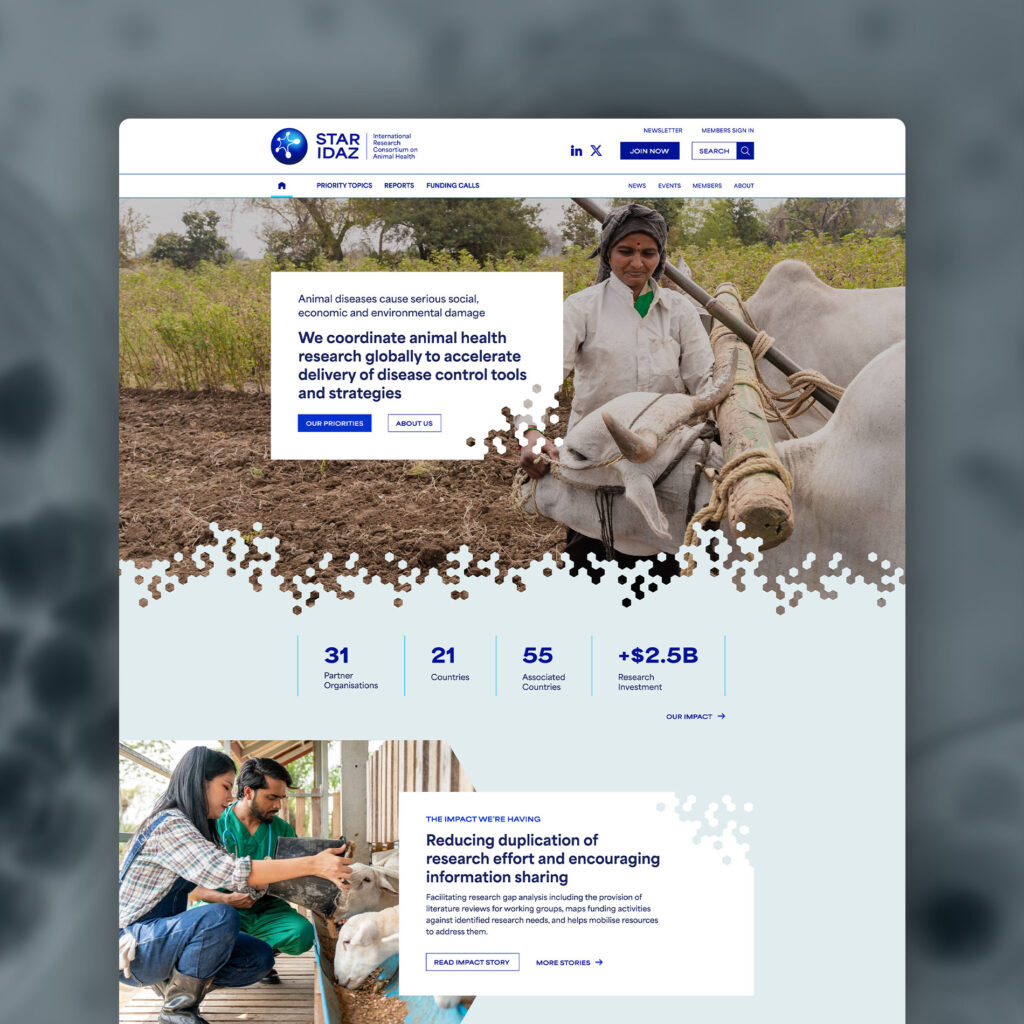
With a further 4.5 years of funding secured and a new generation of the team bringing fresh ambition, STAR-IDAZ asked Modular to bring its digital presence up to the standard of its science. The brief: one domain, one platform, and a home for the roadmaps, projects, reports, communications and brand.
“The work of STAR IDAZ involves complex subject matter. Modular excels at translating these complicated concepts into sleek, intuitive websites, robust database solutions, and engaging digital tools.”
Gareth Dicks, Product Development Manager
The Challenges:
STAR-IDAZ had grown considerably, and its digital tools reflected an earlier chapter in its life. We were asked to gather the pieces into a single platform that matched the scale of the work, and to address five areas in particular.
A platform made of many parts. The website, roadmaps, projects database and members area lived on separate sites, supported by different suppliers, with two separate logins between them. Projects were held in two repositories, there was no single search, and the roadmaps platform was approaching the end of its supported life, so its content needed a new home.
Roadmaps that deserved to be explored. The roadmaps are the most valuable thing the consortium produces. Delivered as static PDFs, they held challenges, solutions and dependencies at every node, and the logic linking research gaps to funding decisions took patience to follow. Usage reflected that.
Communications compiled by hand. The six-monthly newsletter was shared across the eight-person secretariat, roughly three pieces each at about two hours per person: around 16 hours of collective effort. The annual state-of-the-art report took weeks, and distribution relied on manual mail merges. Almost all of the content already existed on the website, so the opportunity was to connect the two.
Twenty priority topics, several audiences. Reports, workshops, roadmaps, events and funding calls spread across 20 topics, and much of it sat several clicks deep. The audience tends to use the web in a traditional way, so findability mattered.
Human First Design:
At Modular, we’ve seen first hand how technology achieves its greatest value when it puts people first. That’s why we begin with human understanding, not technology.
Specialist Audiences
Each audience arrives at STAR-IDAZ with a different question. We started by mapping stakeholders with the team, then interviewed users from each group to learn what they came to the site to do. Those conversations shaped the structure of the platform.
Researchers look for projects in their field, gaps they might bid into, and news from the animal health world. We gave them direct routes into the projects database and the roadmaps, with search that spans both.
Existing funders and programme owners track the priority topics they support. For them, each topic page gathers the roadmaps, reports, events, news and funding calls for that subject in one place.
Prospective funders need a welcoming way in. We designed clear calls to action and a simple path to find out how to get involved.
Scientific Committee, working group and Executive Committee members contribute to the roadmaps and need a dependable space to work with colleagues. We designed a members area that fits how they collaborate.
The secretariat and editorial team are the people who keep the platform alive. We designed their publishing workflows with them, and trained them to manage the roadmaps with confidence.
A global readership, including people for whom English is a second language, who need complex research to be navigable by anyone ready to act on it.
Design Solution:
Research first, design second. Stakeholder mapping and user interviews came before any design work. The team describes the process as co-creation, and it shaped the site’s structure from the first conversation.
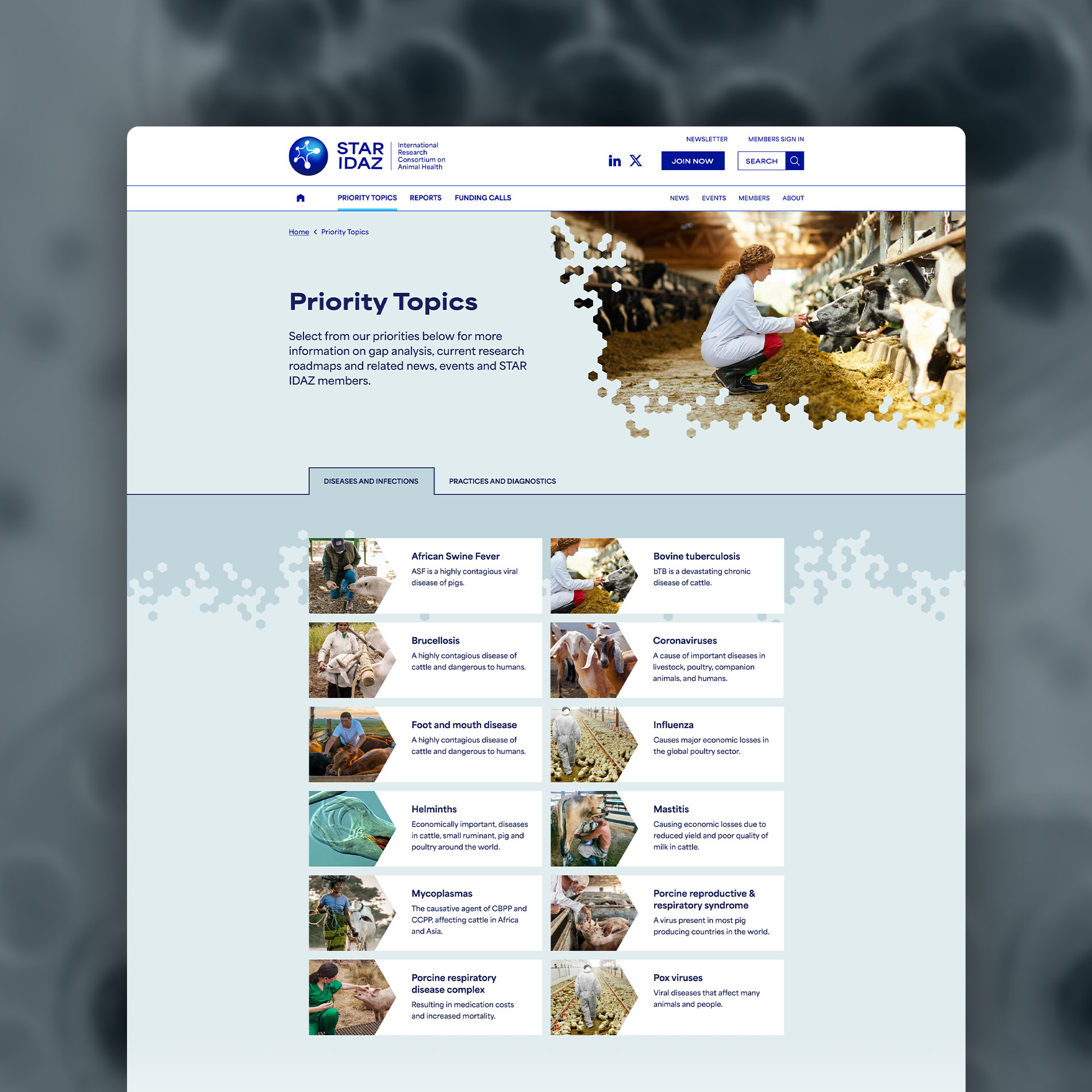
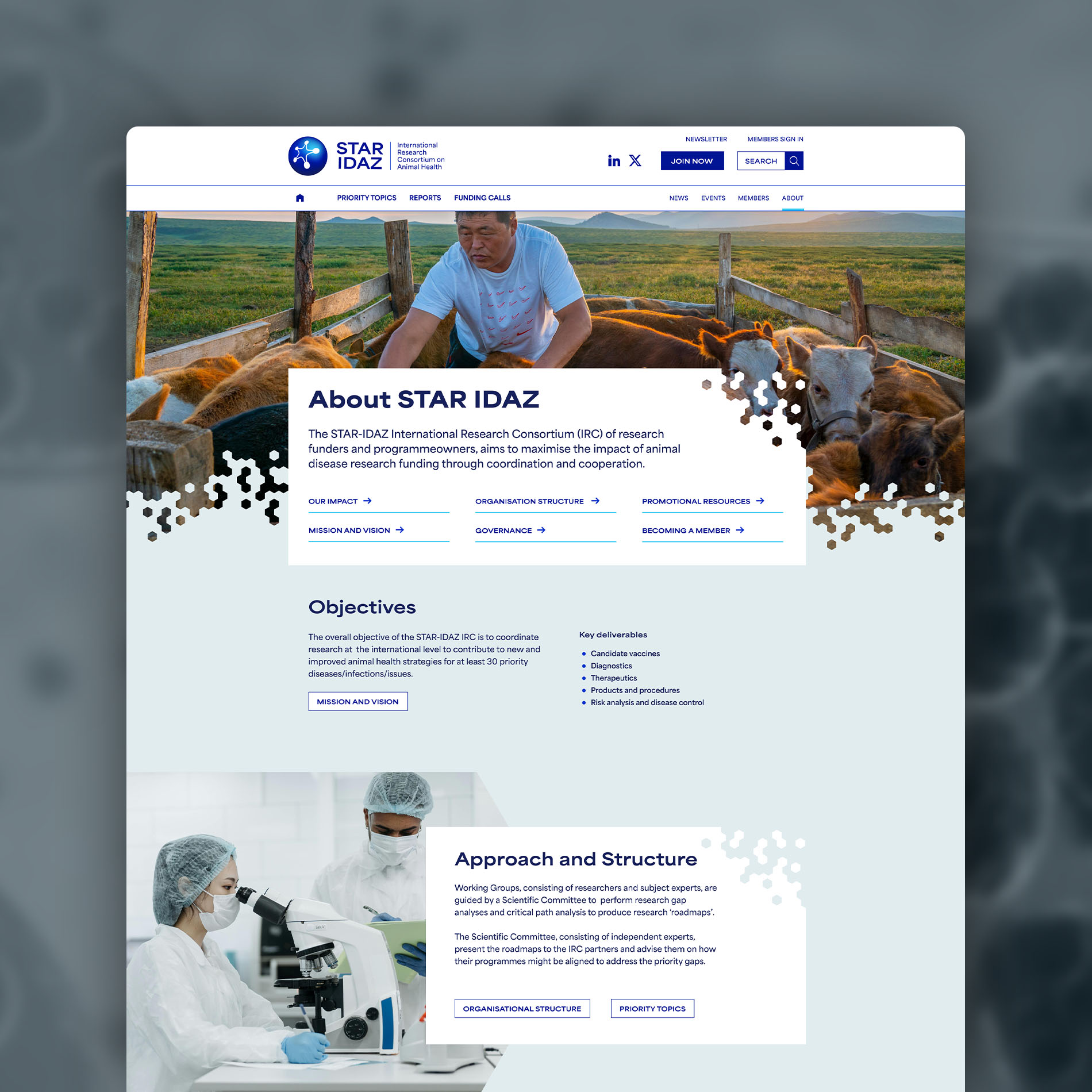
A site organised around priority topics. UX research showed that most visitors arrive with a specific disease or subject in mind. We restructured the site so everything on a given topic is reachable quickly, and brought forward content that had previously sat several clicks deep.
Roadmaps designed as interactive tools. Each roadmap is now a live view of the research pathway. A toggle offers a second way into the same data, and each node scrolls left and right so users can follow the pathway and see the challenges, solutions and dependencies attached to every stage.
A brand and report suite with room to grow. We redesigned the identity to scale at any size and moved the blue to a brighter, more contemporary tone, keeping the STAR-IDAZ name. The report suite was modernised alongside the website, and conference banners carry QR codes that give people a direct route back to the project.
Technical Solution:
One platform on Modular’s WordPress Foundation. The platform brings content management, page building, security, performance, disaster recovery, SEO and analytics tooling together in one place. The editorial team already knew WordPress, so the secretariat started in familiar territory.
Structured content with shared metadata. Priority topics, news, events, projects, roadmaps and reports are structured content types that share a common taxonomy. Tagging by topic and region lets each new item appear wherever it belongs, and topic pages populate themselves. A single search spans roadmaps, projects, news, events and reports.
Roadmap data given a new home. Roadmap leads, challenges and projects from the previous platform were mapped into purpose-built content types with custom fields and relational tagging, so every node keeps its challenges, solutions and dependencies.
An indexed CMS powering communications. We indexed the CMS so that news, events, networks, funding calls and priority topic updates can be pulled automatically into a newsletter or into the annual state-of-the-art report. Newsletters are distributed through the website’s own email system to around 3,300 subscribers, and every item links back to the site.
Connected forms. Subscription and enquiry forms connect with CABI’s existing marketing and CRM tools, so contact data stays with CABI.
A searchable media library. A tagged library sits inside the CMS, holding more than a thousand cleared images organised by priority topic and by individual, with source and licensing information recorded for each.
Deliverables:
Stakeholder Research Programme: stakeholder mapping and user interviews across each audience group, shaping the platform’s structure.
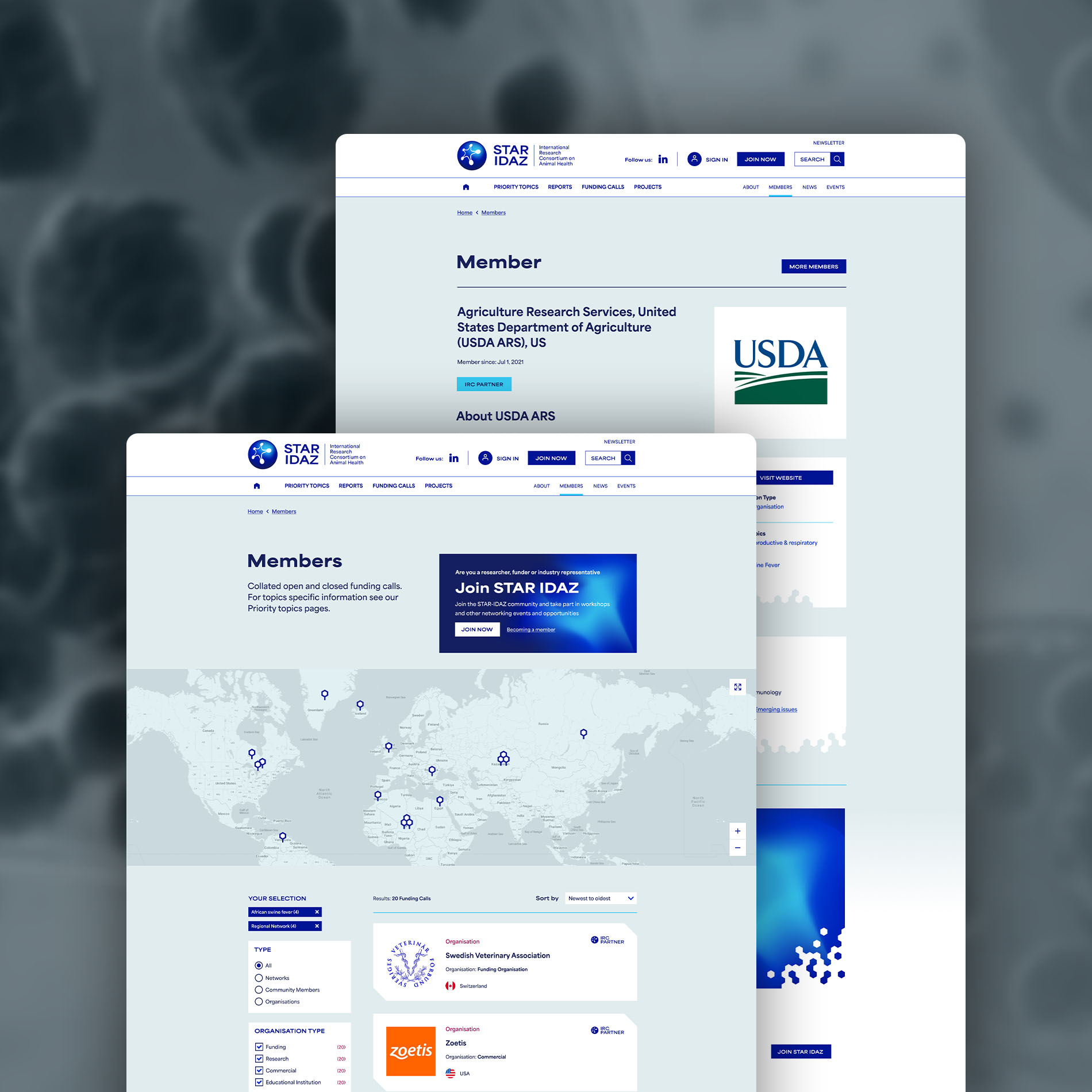
Unified Web Platform: one domain and one login route, built on Modular’s WordPress Foundation, bringing the website, roadmaps, projects database and members area together.
Priority Topic Architecture: a topic-led structure with shared taxonomy and metadata, so news, events, reports and roadmaps gather around each of the 20 topics.
Interactive Research Roadmaps: live roadmap views with a toggle option and horizontally scrolling nodes, managed by the secretariat after hands-on training.
Projects Database and Members Area: working tools for browsing projects and for collaboration among members.
Content Migration: roadmap, project, news and event content moved onto the new platform.
Automated Newsletter and Report System: CMS indexing that assembles the newsletter and the annual state-of-the-art report from existing site content, distributed to around 3,300 subscribers.
Brand Refresh and Report Suite: a scalable identity, a modernised report suite and QR-enabled conference banners.
Media Library: more than 1,100 cleared, tagged images with licensing information recorded.
Secretariat Training: hours of hands-on training so the team can manage the roadmaps and content with confidence.
Impact:
16 hours to minutes: collective time to produce a newsletter
Weeks to minutes: time to produce the annual state-of-the-art report
1,100+: cleared, tagged images in the media library
Days of specialist time returned. The newsletter now needs a short introduction from the secretariat and the rest assembles itself. The state-of-the-art report follows the same pattern. The time saved goes back into the coordination work the secretariat exists to do.
“It’s like a massive headache that’s been cured for us. It takes no time at all.”
Gareth Dicks, Product Development Manager
A site the team puts in front of people. Website usage and analytics have grown significantly from a low base. The members area, the projects database and the roadmaps are all in regular use, and the site has become something the team actively shares.
A network becoming better known. LinkedIn following has grown alongside the digital work. Conference banners with QR codes bring people back to the project in person, and because the newsletter links back to the site throughout, communications build traffic.
Outputs that match the quality of the science. The redesigned reports have drawn consistent praise from stakeholders, the identity works on a banner and a flyer alike, and the media library makes the right image choice the easy one, with licensing risk designed out.
Science that more people can navigate. Complex research is within reach of the people who need to act on it, including those for whom English is a second language. Translation into Spanish, French and Mandarin is an ambition the team has discussed with us for a future phase.
A partnership that keeps growing. Shorter, monthly newsletters, which we recommended, will be adopted in the next phase of the project as part of our ongoing strategic platform support engagement.
“They basically understood what was a really complicated thing, managed to declutter it, and produce an offering that’s a lot easier for the stakeholders and also for us. It’s that managing complexity, and no matter how wacky our ideas, they normally have a solution.”
Gareth Dicks, Product Development Manager
Project Specification
Products
- Bespoke Software
- CMS Website
Services
- Digital Strategy
- Hosting
- Ongoing Platform Support
- Stakeholder engagement
- UI Design
- User Journeys
- UX Design
- Wireframing
Technologies
- PHP
- WordPress
FAQs
How does the Human First Approach to design ensure the success of a project like this?
Human First design makes sure we build the right things, for the right reasons. Funded programmes like STAR IDAZ exist to solve real-world problems, and funders expect a clear return on their investment. That return comes from meeting the needs of the people who will actually use the tool and rely on its outputs.
We start by understanding the problem in depth: who the key stakeholders are, what they are trying to achieve, and where their current ways of working fall short. The solution is shaped by those insights, not by a long specification list or by the technology itself. Every feature earns its place by serving a real need, which keeps the scope focused and the budget well spent.
The result is a tool that people adopt and keep using, because a feature that nobody uses delivers no value, however much it cost to build.
How do you bring several existing sites together into one platform?
We begin by mapping every site, features, integrations, URLs, database and login, then agree a migration and strategy with the client that allows for content that continues to be updated during the build. A shared taxonomy and common metadata then connect topics, news, events, projects, roadmaps and reports, so each piece of content appears wherever it is useful.
Can specialist scientific content be presented as an interactive tool?
Yes. Stakeholder research tells us how each audience reads and uses the content, and design follows from there. For STAR-IDAZ, that meant roadmaps where every node carries its challenges, solutions and dependencies, with two ways into the same data.
Can a platform like this reduce the time our team spends on communications?
It can. By indexing the CMS, we allowed newsletters and annual reports to draw on content that already exists. STAR-IDAZ moved from a full day of collective effort to a short introduction for each newsletter, and from weeks to minutes for the annual report.
How much training will our team need?
We tailor training to the people who will use the platform. The STAR-IDAZ secretariat took part in hours of hands-on sessions, and now manages the roadmaps and content with confidence.
Is Branding an important part of delivering web platforms for global programmes?
Yes, absolutely. Engagement is often a primary aim for programmes like STAR IDAZ, and a strong brand is one of the most effective ways to achieve it. Brand positioning and visual identity build recognition, loyalty and advocacy, which together make up a programme’s brand equity.
That is far easier when the programme has clear messaging, a defined vision, mission and values, and a distinctive visual identity that brings them to life. On a global platform, that consistency helps a diverse audience of researchers, funders and policymakers recognise the programme, trust it and want to take part.


Have a complex digital product, platform or service to shape?
Book a call and we’ll help you explore what’s worth building, how it could work, and where to start.
Book a call